Natural building materials in holiday homes: Why wood, clay and straw are good for you
There are houses that want to impress you straight as you walk in. And there are houses that let you settle in first.
You open the door, smell the wood, feel the warm floor beneath your feet, and watch as the morning light travels across a clay wall. Nothing demands attention. And it is precisely for this reason that something gradually emerges, something often missing in everyday life: peace.
Natural building materials in the holiday home They are far more than a matter of good taste. They shape the atmosphere of a home and influence how a room feels. Wood, clay and straw do not create an artificial backdrop of nature. They are grown materials that bring warmth, texture and a pleasant sense of the natural.
After days full of appointments, screens and noise, you quickly realise whether a house merely promises proximity to nature or truly embodies it.
At Ebner 1822, the three Natural houses made from wood, straw, and clay erected. Not because these materials are currently trendy, but because they fit the location, its history, and traditional craftsmanship. Much of it comes from the region, some of it even directly from our own farm.
Why natural building materials make such a difference in holiday homes
On holiday, few people are just looking for a nice bed and a good view. They are looking for a different rhythm.
The morning can start slower. Breakfast doesn't need a schedule. A book can also be left lying open on the table for the whole afternoon. A Clay and timber holiday home supports this feeling because its surfaces, temperatures and smells feel different from smooth, technically influenced rooms.
Wood shows its grain, its knots, and its slight differences in colour. Clay doesn't absorb light, but allows it to glide softly over the wall. Straw remains hidden in the wall, but contributes significantly to making the house feel pleasant and secure.
Together, this doesn't create an artificial country house style. It creates a house with character.
Of course, it's not enough to plaster a few walls with clay and lay a wooden floor. A natural house also needs thoughtful planning, good craftsmen, and a feel for light, temperature, acoustics, and furnishings.
When all of that fits together, you usually notice it after just a few minutes.
You put the bag down, look out of the window – and feel a little calmer.
Wood: Warmth that needs no decoration
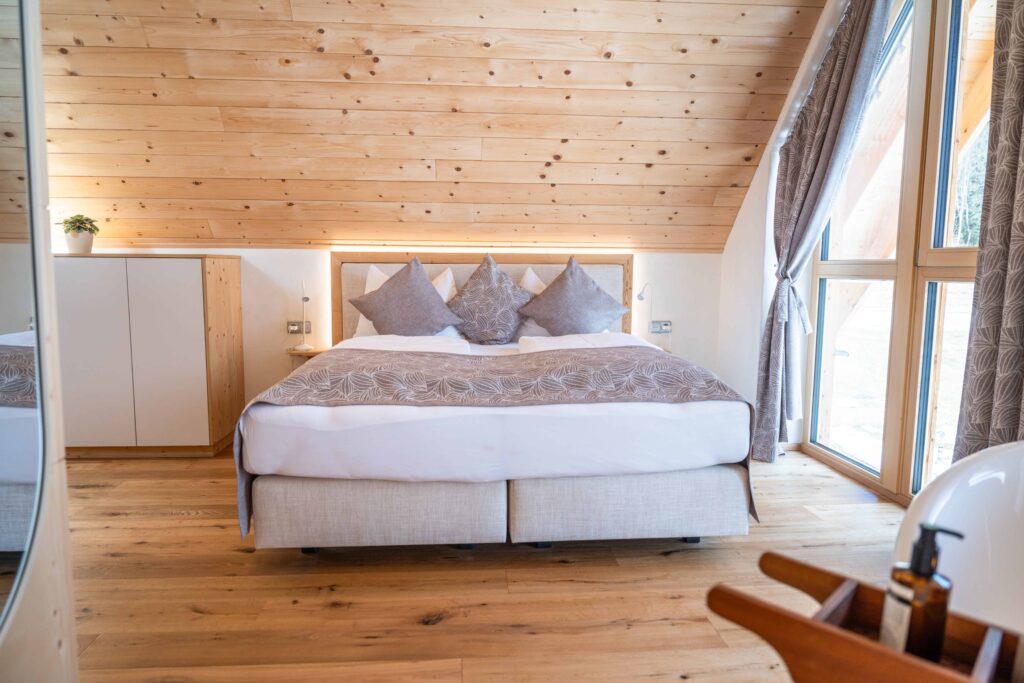
Wood is particularly immediate in a holiday home. You see it, touch it, and smell it. It is encountered as flooring, ceiling, beams, a door, or a piece of furniture.
Its warmth doesn't need to be created through colours, fabrics or decoration. It's already present in the material.
The wood's unique effect lies precisely in its irregularities. Grain doesn't follow a plan. Knots, small cracks, and different colour tones tell the story that no industrially produced veneer was used here, but rather a grown raw material.
This makes a room lively without taking away its peace.
Wood can also absorb moisture from its surroundings and release it again later. proHolz Austria describes this characteristic as a contribution to a naturally regulated indoor climate. How noticeable this effect will be in the finished house depends on factors such as surface treatment, construction, and ventilation behaviour.
Equally important is the origin of the material. At Ebner 1822, a large part of the wood comes from their own forests. It has not only been used as a visible surface, but shapes the construction and character of the houses.
A good wooden house doesn't need to look immaculate even after many years. The material is allowed to age, show signs of wear and tear, and gain character in the process. It is precisely this that creates that sense of comfort, which doesn't need to appear new and perfect to be high-quality.
Clay: Warmth, tranquility and a special sense of space
Clay is one of humanity's oldest building materials. Yet, it appears remarkably contemporary once again today.
One of its special properties is its ability to absorb moisture from the air and release it again later. BauNetz Wissen explains this moisture-buffering effect of clay plaster. Short-term fluctuations in humidity can be mitigated by this. However, the building material does not replace regular ventilation and a professionally designed building envelope.
How clay can be particularly noticeable in the sleeping area is explained in more detail in the article about Clay in the bedroom.
Just as important as its structural properties is its visual impact. A clay wall is rarely perfectly flat. It has depth, shows the traces of craftsmanship, and changes throughout the day.
In the morning, it appears different from how it does in the warm light of the afternoon. In the evening, it becomes a calm backdrop for those things that regain importance on holiday: a good meal, a glass of wine, a conversation, or a book by the fire.
Naturally, clay demands careful handling. In areas that are permanently in contact with water, suitable surfaces and carefully executed connections are required. A clay wall cannot be treated like an industrially coated surface.
This shows that it was handmade. Small imperfections are not a flaw, but part of its character.
Straw: Hidden in the wall and yet palpable
When people think of straw as a building material, some still associate it with simple huts or temporary solutions. This image has little to do with modern straw insulation.
Pressed building straw has been used in professionally designed wall constructions for many years. The air between the stalks slows down the heat flow through the wall. In this way, straw can help to keep the heat in the house during the cooler seasons and to reduce rapid heat gain in the summer.
The quality and processing of the material are crucial. klimaaktiv points to straw insulation among other things, to the moisture content, uniform pressing, and dry storage and processing. Straw must be permanently protected from penetrating moisture and carefully incorporated into the wall structure.
For guests, it mostly remains invisible. Nevertheless, its purpose can be guessed at: from the pleasantly tempered wall surfaces and from a house that doesn't solely need to be comfortable through sophisticated technology.
Straw also tells us something about the origin of a building. It is a renewable resource from agriculture. This means it fits with a style of construction that doesn't just mention regional cycles in brochures, but actually continues them in the build.
A good indoor climate requires more than a single building material
A holiday home should not overheat on hot days and should provide warmth and cosiness in the cooler seasons. Natural building materials can make a valuable contribution to this. However, they do not replace clever architecture.
The orientation of the house, the size and location of the windows, sun protection, insulation, airtightness and ventilation options are at least as important.
This is particularly evident in houses in sunny locations, showing how these elements work together. Large windows bring light and landscape into the room. However, without adequate shading, they can also let in a lot of heat in mid-summer. Good insulation slows down this heat input, while components with appropriate thermal mass can help to cushion temperature peaks.
However, your own ventilation habits remain important. Natural materials can compensate for moisture fluctuations but cannot renew stale air. Healthy indoor climate in a holiday home is therefore always created from the interaction of materials, construction, building services and the people who inhabit the house.
Peace also has to do with acoustics
Whether a room is perceived as pleasant and calm doesn't just depend on what can be heard from outside. The acoustics inside also shape the atmosphere.
Large, hard and smooth surfaces can reflect sound strongly. Voices, footsteps or the clattering of crockery then remain in the room for longer and seem larger than they actually are.
Wooden surfaces, textured walls, curtains, carpets, and other textiles can help to reduce reverberation, depending on their construction and arrangement.
It's not about swallowing every sound. A house can be alive. Conversations should remain audible, wood should creak quietly underfoot, and the fire in the stove should crackle.
It becomes pleasant when no sound pushes into the foreground.
Those seeking peace and quiet on holiday rarely perceive it as a technical feature. You simply notice that conversations sound pleasant, footsteps don't echo through the whole house, and the room doesn't demand anything extra from you.
Building naturally doesn't mean sacrificing comfort
The notion that a house built close to nature must be rustic, dark, or deliberately simple still persists. However, natural materials and contemporary comfort are not mutually exclusive.
Comfort begins with the things that truly matter on holiday: a good bed, pleasant warmth, a functioning bathroom, a well-equipped kitchen, thoughtful lighting, and enough space to retreat.
Modern technology is also welcome. A discreetly integrated heating system, high-quality kitchen appliances, good Wi-Fi, and a private infrared cabin can make your stay easier and more pleasant.
The difference lies in the role technology plays. It should serve without defining the atmosphere of the house.
Materials don't need to be artificially aged or given a rustic look either. Wood can remain wood. Clay can show its texture. And a modern bathroom can fit in perfectly naturally in a craft-built natural house.
At Ebner 1822, wood, straw, and clay are not displayed like exhibits. They are an integral part of houses that are intended to provide peace and privacy.
Timber from one's own woods, organic building straw in the walls, clay plaster on the interior, lime plaster on the exterior and larch shingles on the roofs combine traditional knowledge with modern living comfort.
This attitude belongs to the The idea behind Ebner 1822not to offer as much as possible, but to create a place where the essential is given more space again.
What guests recognise in a harmonious natural house.
Not every piece of furniture made of wood and not every wall in an earthy shade makes a house a natural home.
The crucial factor is whether the choice of materials is convincingly reflected throughout the entire building. Are the surfaces authentic or do they merely imitate a natural appearance? Do the furnishings and lighting complement the architecture? Do the temperature and acoustics feel pleasant? Is it understandable where the materials come from and how the house was built?
Further details on this can be found in our article about, how to recognise high-quality holiday homes.
Another sign of quality is restraint. A well-designed natural home doesn't need lengthy explanations or an array of decorative natural motifs. The materials can speak for themselves.
You feel the wood beneath your feet, see the traces of handiwork in the grazing light, and realise in the evening how much peace a room can offer when it's not filled with stimuli.
When choosing a holiday home, you shouldn't be looking for the most eye-catching picture, but rather for a simple question:
Can I imagine really finding peace here?
Natural building materials alone cannot answer this question. However, they create a good foundation for a couple of days off to become more than just a break from everyday life.
Perhaps no specific furnishings will be remembered in the end. But rather a feeling: warm wood under your hands, soft light on the clay wall, and outside, a landscape that demands nothing further from you.