A holiday home can look beautiful in photos and yet feel surprisingly generic on site. The wooden facade is right, the hot tub is ready, the view is decent – and yet after two days, the feeling of having landed in a well-marketed shell remains. Those who travel consciously quickly realise: high-quality holiday homes are not recognised first by their price, but by the attitude that can be felt behind them.
That is precisely why the question „how do I recognise high-quality holiday homes“ doesn't just arise before booking, but rather at the very first glance at an offer. Quality is rarely demonstrated in grand promises. It shows in materials, dimensions, tranquility, care, and in the way a place treats its guests.
How do I recognise high-quality holiday homes before booking?
The first clue is almost always in the language. If a house only uses superlatives but says little that is concrete, caution is advised. Terms like exclusive, luxurious, or unique, taken on their own, say little. An offer becomes meaningful when it describes what the house is built from, how it feels, who is behind it, and why this place came about in exactly this way.
High-quality holiday homes usually have a clear profile. They don't aim to offer everything to everyone. Instead, they are coherent and consistent in themselves. A house designed for retreat doesn't need the language of events. A nature-focused location doesn't have to impress with artificial intensity of experience. If a provider knows their target audience and consciously omits certain things, it's often a good sign.
The images also reveal a great deal. Perfection isn't what's crucial, but honesty. Does a house appear credible from different perspectives? Do you just see decorative details or also the real rooms, transitions, window axes, materials and the exterior? If photos convey atmosphere without hiding anything, that speaks of substance.
Quality begins with architecture and materials
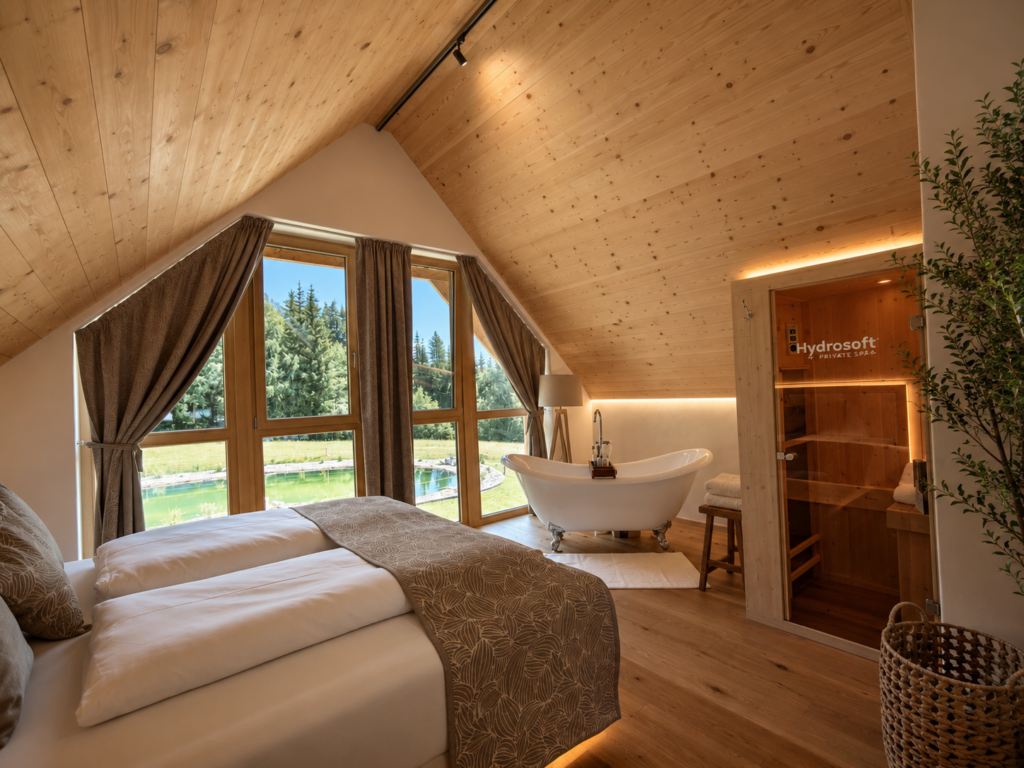
Anyone looking for a high-quality holiday home should look at what remains when you remove cushions, candles, and styling. Good architecture carries a place. It organises light, tranquillity, and proportion. Rooms neither feel cluttered nor empty. Windows are not just large, but thoughtfully placed. You can look out without feeling exposed.
With materials, much separates. Real wood ages differently to a veneered surface. Clay, stone, natural textiles, and well-crafted metals have a quiet self-evidence. They don't need to impress, they have an effect. This doesn't mean that only traditional building methods are high quality. Modern houses can also have great quality. What's decisive is whether materials have been used honestly or merely imitate a natural appearance.
Just in natural surroundings Is this difference noticeable? A holiday home that works with its surroundings feels different to one that merely stands in a beautiful landscape. When interior and exterior spaces converse with each other, when temperature, acoustics, and light are pleasant, that form of comfort arises which doesn't need to be staged.
Location is more than just the view
Many people confuse a beautiful location with a good location. A high-quality holiday home doesn't necessarily need spectacular mountains in front of the terrace. It needs coherence. How is the house situated in the landscape? Is there privacy? Can you hear roads, neighbours, or pool music from the next house? How close are you to nature – and how close, at the same time, are you to anything that could destroy that peace?
Especially in the premium segment Reclusiveness a quality. Not seclusion at all costs, but the feeling of being allowed to be undisturbed. This also includes that the environment is not devalued by densification, standardised rows of chalets or continuous tourist entertainment.
A good place often has its own sense of slowness. Pathways, sightlines, shady spots, a patch of meadow, a quiet morning. Such qualities are difficult to summarise in buzzwords, but you recognise them when a house is not just accommodation, but a genuine place to spend time.
How to recognise high-quality hosts
A high-quality holiday home rarely stands alone. Behind it are hosts with flair. This doesn't have to be intrusive or hotel-like. On the contrary: good hosts are present without being pushy. They build trust because they know and respect their location.
This is evident even before arrival. Answers are personal, clear, and reliable. Questions aren't dealt with using pre-written responses. You can tell if someone is merely renting out or indeed the host is. He who manages his household carefully, usually does so in communication too.
This impression continues on site. Is there thoughtful information instead of overloaded guest folders? Are recommendations interchangeable or do they come from people who truly live in the region? Small things often make the difference here – a good breakfast basket, honest tips for walks, a feeling of being welcome without being staged.
That's precisely where the strength of places like Ebner 1822 lies: not in volume, but in personal quality. When a house is part of a developed farm, a landscape, and a culture of hospitality, you feel that differently than in anonymously run concepts.
How can I spot high-quality holiday homes by looking at the details?
Those who look more closely will often find quality in the quiet zones. How is the bed? Not decorative, but genuinely good. How do the rooms block out light? What does the house smell like? Is there enough storage space, good quality crockery, pleasant towels, good lighting in the evening, a table you'll enjoy sitting at for a long time?
Many accommodations invest in visible effects and skimp on what actually makes a stay enjoyable. Then there's the freestanding bathtub for the photo, but poor acoustics in the bedroom. Or the designer kitchen missing a decent knife. High-quality holiday homes don't stand out through extravagance here, but through consistency.
The condition and patina also need to be read correctly. Not everything needs to be new. Quality can show signs of wear if it is well preserved. It becomes problematic where signs of wear betray neglect. Worn textiles, makeshift repairs or discordant retrofits rarely speak of a considered standard.
Sustainability as a mark of quality – but not as a label
For many guests, sustainability has long been a question of quality. But it's worth taking a closer look here too. What advertises with green vocabulary is not automatically high-quality. A holiday home becomes truly credible when ecological decisions are evident in the overall concept – in construction, energy use, materials, regional products, and a natural approach to resources.
This is especially crucial for natural retreats. Those promising peace, landscape, and originality shouldn't just quote these values in their aesthetics. A house made of honest materials, with regional connections and a focus on the essential, often conveys more sustainability than any ostentatious self-description.
Furthermore, sustainability is not a programme of renunciation. It becomes valuable when it makes the stay more pleasant. A pleasant room climate, good food, natural surfaces and durable furnishings are not a moral exercise, but part of genuine quality.
The difference between expensive and high-quality
Not every expensive holiday home is high-quality, and not every simple home is basic. The price can be an indicator, but not proof. High prices can also be driven by location, season, demand, or market trends. Quality, on the other hand, is demonstrated by whether the experience makes the price internally plausible.
This is a subtle but important difference. When architecture, tranquility, amenities, hospitality, and surroundings all harmonise, the price seems justifiable. However, if a lot of money is charged for mere staging, but the experience remains interchangeable, disappointment quickly sets in.
Discerning guests aren't looking for luxury in the ostentatious sense. They're looking for a house that endures. A place that doesn't look like a concept, but like a conviction. This could be minimalist, warm, handmade, modern or rustic. What matters isn't the style, but the authenticity.
When a holiday home is truly right for you
Perhaps the most important question in the end is not just: Is this house of high quality? But also: Does its quality suit my style of travel? Those seeking entertainment, infrastructure, and constant choice might miss something in a quiet retreat. On the other hand, those who appreciate space, privacy, natural materials, and quiet hospitality will find the greatest luxury precisely there.
High-quality holiday homes aren't just recognised by stars, equipment tables or trendy pictures. They are recognised by the fact that they fulfil a promise without constantly stating it. They still have an effect even when the phone is put away, the evening becomes quiet and nothing else distracts.
If you focus less on effects and more on coherence when choosing, your perspective changes. You're not just looking for a nice house for a few nights. You're looking for a place where tranquility has become believable.