
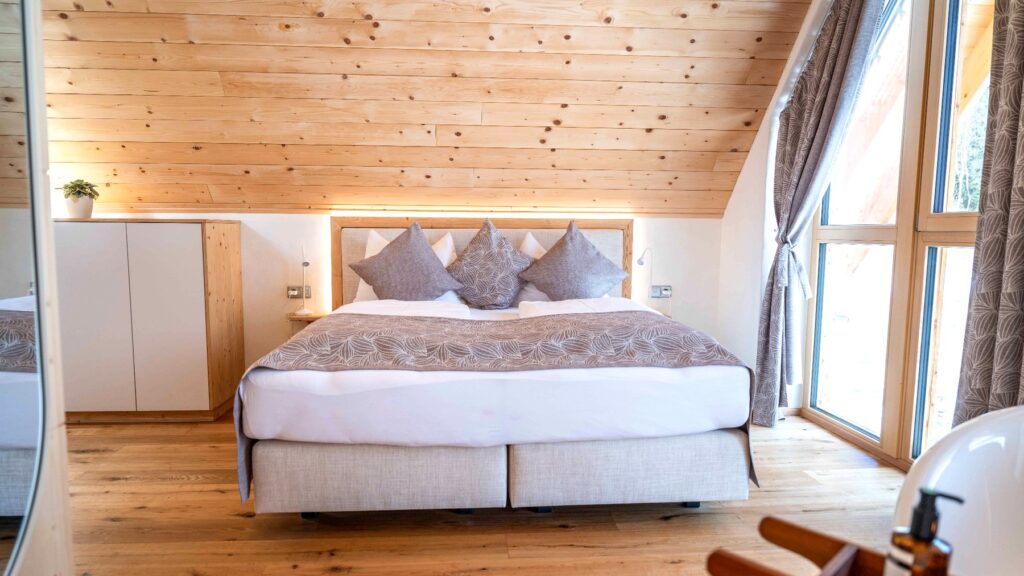
Clay in the bedroom: How natural materials influence room climate and tranquility
Clay in the bedroom is more than just a detail in sustainable building. Anyone who has slept in a room with clay walls often doesn't remember the wall first. But the air. The quiet. The feeling of a room that feels softer, more balanced, and less artificial. That's exactly what clay in the bedroom is about: not a trend in sustainable building, but a quality that you particularly notice at night.
At Ebner 1822 in Carinthia, clay isn't just a decorative detail. The three hand-built natural houses are made of wood, straw, and clay. Together, these materials form spaces that don't need to impress. They are intended to warm, calm, and provide a retreat that feels authentic.
How does clay work in the bedroom?
Clay doesn't spectacularly change a room. It has a modest effect. One of its most important properties is that it can absorb moisture from the room's air and release it again when the air is drier. This creates rooms that often feel more consistent.
This property is particularly important in the bedroom. Windows are often kept closed at night. People breathe, warmth builds up, and the air changes. Clay can help to buffer such fluctuations. It doesn't replace ventilation or good construction, but it supports a Healthy indoor climate in a holiday home, which many people describe as pleasant and balanced.
Visually, too, clay contributes to a sense of calm. The surface feels warm, matt, and vibrant. It reflects light gently, without being harsh or shiny. Sleep rarely begins in bed. It begins in an environment that doesn't demand too much of you.
Room climate as quiet luxury
In the bedroom, it's often small irritants that cause restlessness: dry heating air, stuffy corners, hard surfaces, large temperature fluctuations, or materials that feel cool and technical. Clay can naturally counteract such irritants. Not perfectly. But noticeably.
Its ability to buffer humidity is central to this. If moisture builds up during sleep, a clay surface can absorb some of it. When the air subsequently becomes drier, the clay surface slowly releases moisture back into the air. This makes the room feel less stuffy.
This does not mean that every room with clay is automatically ideal. Ventilation, room size, furnishings, heating behaviour and construction method remain crucial. Clay is not a miracle cure. It is a material that shows its strength in the right combination.
This can be an advantage, especially in well-insulated buildings. Where rooms are quickly perceived as stuffy or dry, a vapour-permeable material helps to make the climate feel more natural. Technically, this property is often described as moisture buffering. Those who want to delve deeper will find information on this at Fraunhofer Institute's factual classification of moisture-buffering materials. In everyday life, however, it's less about measured values and more about a form of comfort that comes from well-chosen materials.
Why clay really counts in the bedroom
In a living room, one forgives many things. In a bedroom, not. There, every detail is more immediate. A room can be beautifully furnished and still not radiate true peace. Or it can be simple and feel astonishingly cosy.
Clay tends to support the latter. It brings a tactile and visual naturalness that isn't meant to be decorative. It doesn't push itself to the forefront. That's precisely what makes it valuable.
Bedrooms need reduction. Fewer technical stimuli. Fewer artificial surfaces. Less hardness. Clay fits this bill because it doesn't appear staged. Its beauty arises from depth, structure, and craftsmanship.
At Ebner 1822, clay combines with wood and straw to create a peaceful whole. The nature houses are not built as a backdrop, but as retreats for people who travel consciously. Couples, in particular, find a place here where privacy, nature, and honest luxury come together. More on this in the article about A holiday for two in Carinthia.
Clay and Sleep: What Can Realistically Be Said
Clay is not a medical promise. It does not cure sleep problems and does not replace fresh air, darkness, rest, or a good mattress. Those who sleep poorly will not become good sleepers solely through clay.
Nevertheless, it would be an understatement to say that clay is merely pleasing to the eye. Sleep depends heavily on the environment. Air, temperature, acoustics, light, and materiality all work together. Clay can be a good partner in this interplay because it doesn't overstimulate the space. It doesn't have an artificial smell, doesn't feel smooth or sterile, and brings a calm earthiness to the room that many people find soothing.
Those who experience a lot of screen time, pace, and sensory overload in their daily lives often notice such differences quite clearly. A bedroom made of natural materials can then be more than a question of style. It becomes the opposite.
More about this interplay of Wood, straw and clay The building history of Ebner from 1822 is told. It becomes clear why natural materials are not seen as a trend here, but as the basis for a different feeling of living.
The sound of a room also changes
An often underestimated point is acoustics. Smooth, hard surfaces make rooms sound more resonant more quickly. Natural, textured surfaces are often perceived as softer. This doesn't make a bedroom soundproof. But it can help sounds not feel as harsh in the room.
This is particularly noticeable in the evening. Footsteps, voices, the closing of a door, wind at the window: all of these belong to a house. What's crucial is whether a room amplifies or dampens these sounds. A bedroom isn't about complete silence, but about an atmosphere in which peace is possible.
This is precisely where a quality lies that suits Ebner 1822 well. Here, relaxation is not created through a constant programme, but through distance, natural materials, meadows, forest, a natural pond, and a hospitality culture that remains personal. The article also describes why this kind of tranquility has become so valuable today Why Silence is the New Luxury.
What clay can't do
Anyone who wants to know how clay affects a bedroom should also be aware of its limitations. Clay does not replace a well-thought-out construction method. If a room is constantly poorly ventilated, remains too damp, or has structural defects, clay won't solve that on its own.
The surface also requires conscious handling. Clay is not as impact-resistant as some industrially coated walls. This is usually not a problem in a bedroom, but it is an issue in areas with heavy use. Clay also tolerates direct moisture only to a limited extent. Therefore, it belongs where material, use, and craftsmanship are a good match.
Those seeking sterile perfection may not be happy with clay. Clay shows character. Small structures, lively surfaces and traces of craftsmanship are all part of it. Its beauty lies precisely in this.
Ein Schlafzimmer mit Lehm ist besonders angenehm für Menschen, die ein natürliches und gesundes Raumklima schätzen. Lehm reguliert die Luftfeuchtigkeit, was zu einem besseren Schlafklima beiträgt und Allergikern zugutekommen kann. Zudem hat Lehm eine gute Wärmespeicherfähigkeit, was im Winter für angenehme Wärme und im Sommer für eine kühlere Atmosphäre sorgt.
Clay is particularly well-suited to people who perceive fine differences. Those who find dry air unpleasant, who avoid overheated rooms, or who find it difficult to relax in artificial-feeling interiors will often quickly notice the sense of atmosphere.
Clay is also interesting for design-conscious guests. Not because it's being rediscovered. But because it looks high-quality without being intrusive. Its depth comes not from high gloss, but from material, light and structure.
At the same time, clay suits people who don't see sustainability as just a label. The material is natural, steeped in tradition and rooted in craftsmanship. It doesn't talk about sacrifice, but about a different kind of quality: less surface, more substance.
Thinking correctly about clay: as part of a whole
Clay works best where it's part of a harmonious whole. A bedroom doesn't just gain value from a clay wall if harsh lighting, restless furnishings, and artificial surfaces dominate the surroundings.
This includes natural textiles, muted colours, good air quality, pleasant warmth, and sparing use of technology. Clay supports this approach. It is not a material for effect, but a calm supporting player.
At Ebner 1822, this idea is particularly evident in the nature houses. Wood, straw and clay form the basis. In addition, there is a lot of privacy, a Breakfast basket in your own holiday home, the village inn at the court, and the surrounding nature. It’s not a holiday that needs much explanation. It’s felt in the small things: in the morning light, in the evening sounds of the house, at night in the stillness of the room.
An old material for today's spaces
Perhaps the special effect of clay also lies in the fact that it is older than many modern living ideas. It brings something primal with it without being backward-looking. In a well-made bedroom, it connects craftsmanship, nature, and the present in a way that doesn't need explaining.
You don't just see that. You sleep in it.
Anyone looking for a retreat that isn't just furnished, but has atmosphere, will rarely experience clay as a single detail. But rather as a calm quality that you notice in the morning because the night was good.