
What is a slow holiday really?
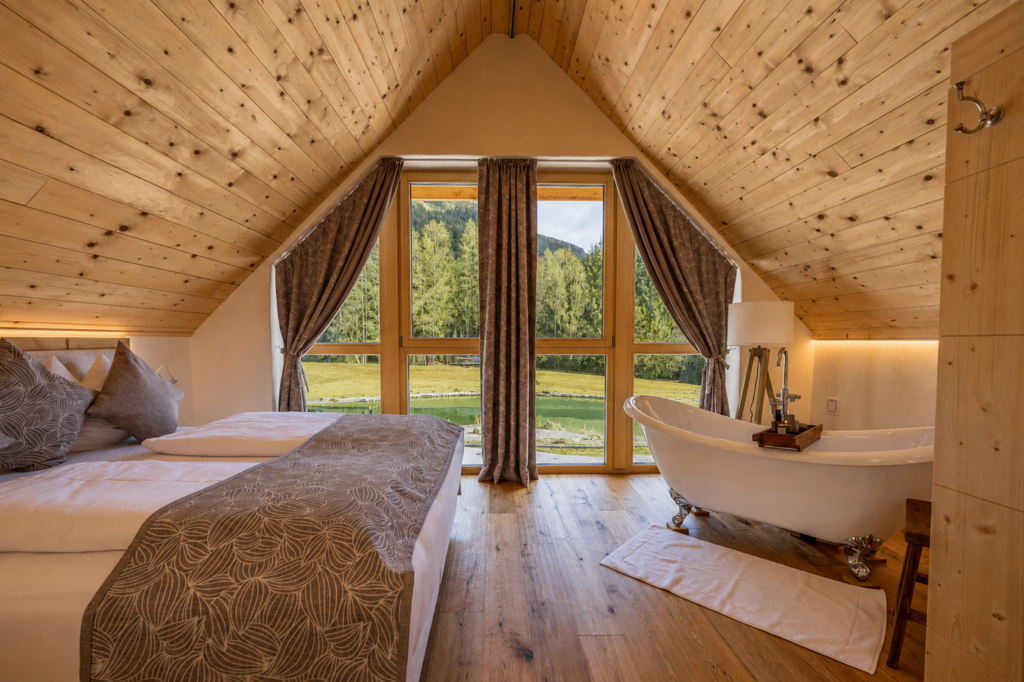
The first morning doesn't begin with reaching for your mobile phone, but with sunbeams on the wooden floor, the gentle lapping of water at the pond, and a cup of coffee for which no one is watching the clock. A decelerated holiday is this rare form of travel, where the aim isn't to experience as much as possible, but to hear your own rhythm again.
Slowing down is not an empty promise, nor is it a programme that is organised from morning till night. It arises where there is space: between breakfast and a walk, between a book and a view of the landscape, between a good meal and an evening that has no further plans.
What does a slow-paced holiday mean?
A de-stressed holiday is a conscious break from speed, sensory overload and constant availability. It is not against activity. A hike, a bike ride or an excursion can be a wonderful part of it. The difference lies in the attitude: the day is not crammed to make it worthwhile. It is allowed to remain open.
Many people travel with the same internal rhythm they are used to from everyday life. Appointments are replaced by reservations, commutes by excursion routes, and a full calendar by a list of sights. In the end, much was enjoyable, but the mind hasn't truly come to rest.
Travelling at a slower pace, by contrast, means letting go of the demand to make every hour meaningful. It means not rushing between the buffet, spa appointment, and evening entertainment, but choosing a place that offers substance even without constant activity. A place where silence is not perceived as a void, but as a quality.
Why rest takes time
Recovery doesn't usually start in the first hour after arrival. The body needs time to shift out of its 'functioning' mode. This often manifests unremarkably: you sleep longer. You move slower. You suddenly realise how loud everyday life has been.
This is precisely why the length of your stay is not unimportant. A weekend can be a restorative break. For a deeper sense of settling in, three, four or more nights are often more valuable than ticking off as many destinations as possible in a short amount of time. Those who don't have to leave again straight away can gradually change their own rhythm.
This naturally depends on your personal life circumstances. Some people are primarily looking for retreat and quiet after intense weeks. Others want to combine nature with small excursions. Deceleration doesn't require a specific number of steps or digital asceticism at all costs. It begins with the freedom to decide for yourself what feels good right now.
The right environment makes all the difference
Not every accommodation supports this type of relaxation. A large house with many guests, noise in the corridors, and a tightly scheduled programme can be pleasant, but often leaves little room for privacy. Those seeking peace, doesn't need the widest possible selection. More important are a private refuge, a natural environment, and an atmosphere that doesn't constantly demand attention.
Natural materials play a quiet but palpable role. Wood, clay and straw feel different from smooth, anonymous surfaces. They retain heat, create a pleasant atmosphere and give rooms character. A house that is conceived with craftsmanship and built with its surroundings in mind needs no artificial backdrop. It also makes being outdoors an indoor experience.
In addition, there is the outside view. Meadows, woods, a still pond or a wide horizon are not mere decoration. They change one's perspective and often one's thoughts too. Those who look out at the landscape in the morning don't need to consume anything to experience something. Sometimes it's enough to watch the wind in the grass or to sit at the edge of the woods, even though the walk could have continued long ago.
Less programme, more personal time
A slow-paced holiday doesn’t follow a set schedule. That, in particular, can feel a bit strange at first. When there’s no set routine to follow, it becomes clear just how used to being busy we are. That first hour of free time can almost feel unsettling. Over time, however, it becomes something quite soothing.
It helps not to overload the day with expectations. Perhaps it begins with breakfast at home. Perhaps it leads to a quiet path, to a spot with a view or to a village not made for a quick look around. Perhaps you simply stay on the sun lounger in the afternoon, read a few pages and fall asleep. This is not time wasted. It is time that belongs to your own feelings again.
Cuisine can also have a calming effect, provided it doesn't become a performance. A breakfast basket In front of the door allows for an unhurried morning. A freshly cooked, seasonal meal brings the taste of the region to the table without it becoming a mandatory appointment. Good ingredients, a small menu and honest preparation often bring more peace than excess.
Slowing down doesn't require complete seclusion
Retreat does not mean being cut off from everything. Many guests appreciate recommendations from people who know their region: a path that is pleasant even on warm days, a quiet swimming lake, a small cultural spot, or a restaurant that serves regional cuisine. The difference lies in whether these suggestions are understood as an invitation or as a mandatory programme.
Personal hospitality therefore fits particularly well with de-escalated travel. It is attentive, but not intrusive. It knows the right distance. A brief exchange upon arrival, a suitable tip for the next day, or the knowledge that someone is there if needed, provides security without intruding on privacy.
At Ebner 1822 in Carinthia, this exact attitude is part of the experience: three individual retreats, a courtyard steeped in history, and natural spots that don't need explaining to have their effect. Those who wish can find their personal favourite spot by the natural pond, in the literature nook, or on a quiet path through the woods. Those who prefer to be on their own can simply close the door and let the day unfold.
Less digital, not dogmatic
Completely switching off your mobile phone can be liberating for some, but unrealistic for others. A slower-paced holiday doesn't have to be a project of deprivation. The crucial factor is whether digital technology dictates your stay or if it's put back in its place.
Perhaps it will remain the telephone in the morning still in the other room. Perhaps messages are only answered once a day. Perhaps photographing everything becomes a conscious focus on a few moments. The landscape doesn't need to be shared immediately to be beautiful. A conversation doesn't need to be interrupted because a notification lights up.
These small decisions change more than one might assume. Attention is limited. If it's not constantly pulled in many directions, smells, light, taste, and encounters become clearer again. One remembers not just images on a screen, but the feeling of a place.
A slow-paced holiday is suitable for anyone who wants to relax and unwind, disconnect from the everyday hustle, and enjoy their surroundings at a leisurely pace. It's ideal for those seeking a stress-free escape, individuals who appreciate mindfulness and being present in the moment, and travellers who prefer quality experiences over ticking off a long list of sights.
Slow travel is particularly suitable for people who carry a lot of responsibility in their daily lives, are frequently reachable, or long for a break without expectations. Couples find time for each other in this way, without outside entertainment filling their days together. Solo travellers find a framework in which being alone does not have to be lonely.
This type of holiday also often appeals to people who appreciate design, craftsmanship and good food. Not because everything has to be perfectly designed, but because quality can bring peace. A well-made house, a comfortable spot by the window, natural materials and genuine hospitality help one to settle in more easily.
This form of travel is less suitable for those who expect action every day, a large wellness area, or a packed programme of events. That's not a question of better or worse. They are different needs. De-stressing is successful when it doesn't feel like a concept, but like permission.
How the peace remains even after the journey
The most precious memory isn't always the most spectacular view. It can be the moment the morning started without an alarm. The long conversation over a meal. The walk taken without a destination. Such experiences can't be preserved, but they can shift something in our everyday lives.
Perhaps one evening a week will remain free of appointments after returning. Perhaps Sunday breakfast will be more relaxed. Perhaps the phone can be put down more often, while a short walk awaits outside.
A decelerated holiday doesn't make everyday life disappear. But it reminds us that a different rhythm is possible – and how good it feels to give it a little more space again.