
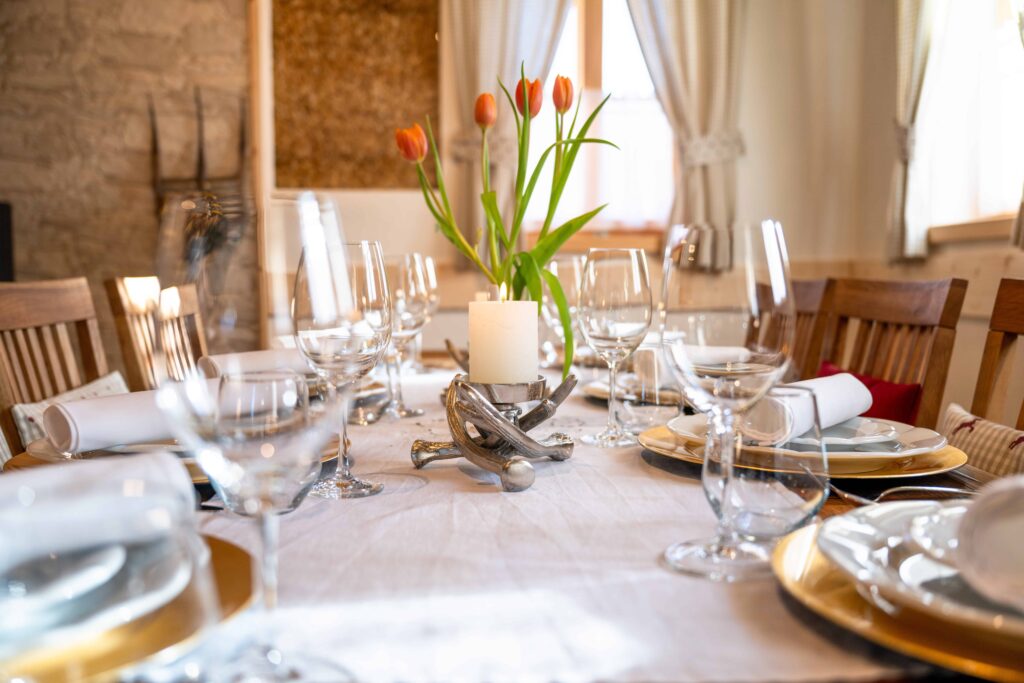
The morning doesn't start at the buffet or with a glance at the clock. It starts with the scent of fresh bread, with eggs from our chickens, local cheese, and the question of whether the day will lead to the lake, the forest, or simply to your own terrace. A Nature holiday with a culinary focus This is precisely where it starts: with food that has an origin, with time to savour the taste, and with a landscape that opens up the mind again.
Those who travel consciously rarely seek just a beautiful place to stay. They look for a place where everything feels right: the wood under their hands, the light on the meadows, an honest meal after a long walk. Here, cuisine is not an optional extra. It connects people with a region, its seasons, and the people who live and work there.
When culinary experiences make your holiday more relaxing
Good food can accompany a day without dictating it. A leisurely breakfast provides a different start than a quick coffee before the next excursion. A dinner with a few, carefully selected ingredients often tells more than a long menu.
In a nature holiday, enjoyment comes not from abundance, but from mindfulness.
This starts with the question of what is currently growing and who produced it. Earthy potatoes, herbs from the garden, cheese with character, ripe berries in summer, or a hearty dish after an autumn day in the forest: seasonal cuisine brings the countryside to your plate. It doesn't taste the same all year round. And that, precisely, is what makes it authentic.
A culinary-focused stay can be simple. Not every meal needs to be staged, and not every evening requires a multi-course menu. Often, it's the unpretentious things that remain in our memories: a breakfast basket on the doorstep, a soup after a downpour, a glass of wine with the window open, and the silence that doesn't need to be filled afterwards.
Origin instead of interchangeability
Regional cuisine is more than a label. It means short distances, established relationships, and the courage to adapt to what the season offers. The selection in winter is different to that in midsummer. And in a small kitchen, a dish might sometimes sell out because shopping is done consciously and not in bulk.
For people who value quality, there lies a special worth in that.
Interchangeability rarely leaves memories. Those who eat bread baked nearby in the morning or enjoy a dish in the evening whose ingredients suit the surroundings perceive the place differently. The landscape doesn't remain mere scenery. It becomes part of the experience.
A nature holiday with a culinary focus needs space.
Culinary enjoyment unfolds particularly well when nothing competes for attention between meals. No packed schedule, no noise by the pool, and no expectation to make use of every hour of the day. Instead, there's a walk through the woods, a spot by the water, or a bench with a view over the meadows.
These spaces also change the taste. After a morning in the clear mountain air, a simple lunch is consciously savoured again. After a swim in the natural pond or a quiet hour with a book, dinner can last longer. Not because it has to be spectacular, but because one's own rhythm becomes palpable again.
For some guests, this includes cooking for themselves. Holiday home with well-equipped kitchen gives the freedom to prepare regional purchases according to one's own ideas. Others consciously do not want to plan on holiday and look forward to a meal at the village inn.
Both can be correct. What's crucial is that the cuisine fits the location and the people – and doesn't come across as an interchangeable extra offering.
The breakfast basket as a personal form of hospitality
A regionally filled breakfast basket is a quiet and very personal gesture. It preserves the privacy of the holiday home while simultaneously taking away the guests' first organisational question of the day.
No one has to stick to a fixed breakfast time or look for a spot in the dining room. Those who want to sleep longer, sleep longer. Those who want to go out early can start the day a bit earlier. The morning can follow your own habits.
At the same time, the breakfast basket brings the region directly into your home. Fresh bread and pastries, butter, cheese, eggs, yoghurt, jams, fruit and juices are not a minor detail. Your selection shows how hosts understand their location and what is important to them personally.
Especially for people who have to organise, decide and be available a lot in their daily lives, it is beneficial when quality is already prepared, without making it a rigid programme. Breakfast can take a long time. But it can also be just the start of an early walk.
Carinthia tastes of the season and the landscape.
Carinthia combines sunny altitudes, lakes, forests and agriculturally influenced cultural landscapes. The cuisine also thrives on these contrasts. It can be hearty and down-to-earth, but at the same time it can taste light, refined and surprising.
In spring, the first herbs herald new beginnings. Summer brings berries, salads, ripe vegetables, and long evenings outdoors. In autumn, mushrooms, apples, pumpkins, and heartier dishes accompany the cooler days. In winter, home draws closer: with warmth, good provisions, soups, tea, and the quiet pleasure of looking out without having to go out.
Those who understand cuisine as part of travel don't need to visit a new restaurant every day. Often, less is more here too: a good dinner, a trip to local producers, a glass of wine, and enough time in between.
How to recognise a credible pleasure spot
A place with a culinary ethos doesn't just talk about regionality. It makes it visible in small ways. The hosts know where their food comes from. The dishes change with the seasons. Architecture, atmosphere, and cuisine don't feel disconnected from each other. And even where everything remains simple, care is palpable.
Ebner 1822 combines this stance on a sunny high plateau in the upper Gurk Valley with three hand-built natural holiday homes made of wood, straw, and clay. The organic breakfast basket is brought directly to your house. In the Village pub Barbara cooks with regional ingredients and a high proportion of organic products. The cuisine is dictated by the season, by availability and by what is currently really good.
That Ebner was awarded five flowers and 70 out of a possible 70 points by „Urlaub am Bauernhof“ (Holiday on the Farm) in 1822 fits with this understanding of quality. It doesn't need to be loud. You can recognise it in the materials, in the care taken, and in the way people are welcomed.
The surrounding nature is not just a decorative backdrop. Meadows, forest paths, the natural pond and the literature square create those pauses that make enjoyment complete. Drinks are available in the fridge at Ebner Beach. At the literature square, spring water, beer, spritzers, and schnapps are cooled in a water trough. Guests are welcome to help themselves.
Not because every glass is to be charged. But because we at Ebner 1822 want to do something good for people.
For us, true hospitality begins exactly there.
Luxury no longer means abundance
Luxury is often associated with grandeur, choice, and as many services as possible. At Ebner 1822, we understand this differently: more peace, more nature, and more personal time.
Peace needs space. That's why we only have three houses.
We don't want to create a place where guests feel they have to experience as much as possible. We want to give them a retreat where they can find their own rhythm again. This includes good materials, honest food, and hosts who are attentive without being obtrusive.
The most beautiful things at Ebner 1822 can hardly be written down on a list of achievements anyway: the first light over the meadows, a quiet afternoon by the pond, an unexpected conversation in the village inn, or a cool drink in the literature square.
It's a luxury that takes a step back.
What remains from a culinary nature holiday
A good Nature holiday with a culinary focus leaves behind not only photos and recommendations. It sharpens our eye for the simple: for good bread, for the right season, for an evening without distraction, and for the people behind the food.
Perhaps you don't take away a grand revelation, but just a small change in your daily routine: drinking your coffee at the table again, asking more often about the origin of goods when shopping, or not immediately scheduling a free afternoon.
Those seeking a break should not focus on how much can be experienced in a few days. The better question is:
What should remain when the journey is over?
A place where nature, honest cuisine, and genuine hospitality come together, doesn't offer a loud answer. But perhaps one that resonates for a long time.