Holiday home with personal host culture: Why true retreat needs more than beautiful rooms
The difference often isn't apparent upon arrival, but on the second morning. Then, when the view from the window isn't of a car park, but of meadows, trees, and light. When there isn't a hotel corridor outside your door. When nobody wants anything from you. And when a Holiday home with personal host culture not just accommodation, but a place where one can slowly arrive at oneself.
Even people who organise, decide and achieve a lot don't look for more activities on holiday. They look for the opposite. Fewer stimuli. Less scheduling. Less interchangeability. A place that wasn't made for as many guests as possible, but for a few who choose consciously.
With Ebner 1822 In Kärnten, the idea of a different kind of holiday begins right here: three handcrafted natural houses made of wood, straw, and clay, personal hosts, plenty of privacy, and a farm culture that doesn't need to be loud to be moving.
What makes a holiday home with personal host culture
Personal host culture is not a decorative addition; it is the attitude behind a stay. It is not shown in forced attentiveness, but in a well-measured form of presence. You feel welcome without being overbearing. You are cared for without it becoming a programme.
In a good holiday home of this kind, many things are palpable before they need to be explained. The house has style. The materials have substance. The rooms don't seek to impress, but to soothe. Wood, clay, fabrics, light, the scent of nature – all contribute to the fact that relaxation doesn't need to be organised.
Host culture also means that someone is behind the place. Not an anonymous brand, not a standardised rental operation, but people with a feel for atmosphere. People who know when a tip for a quiet walking path is more valuable than any brochure. And who understand that privacy can itself be a form of hospitality.
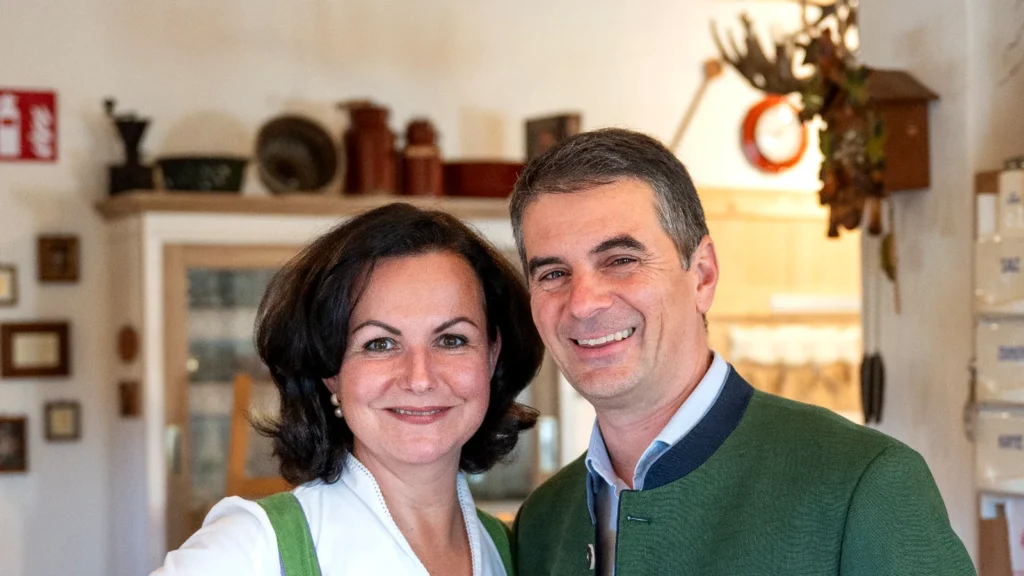
At Ebner 1822, Barbara and Mario Sonnleitner are precisely these hosts. Barbara brings her experience from Viennese cuisine and gastronomy, while Mario contributes his expertise as a hotelier, farmer, and builder. Together, they haven't created a standard holiday operation, but rather a place with a distinct style.
Why many premium guests are looking for exactly that today
Anyone familiar with high-quality accommodation can quickly recognise the difference between amenities and attitude. Good beds, beautiful bathrooms, harmonious architecture and comfort are important. But true quality only emerges when everything fits together: the house, the surroundings, the peace and quiet, the hosts, the food and the rhythm of the place.
Many classic holiday formats miss this very point. Hotels offer comfort, but often also proximity, bustle, and rigid routines. Chalet complexes promise seclusion, but not infrequently feel like duplicated concepts with little soul. Holiday apartments can be charming, but often remain anonymous. A holiday home with personal hospitality culture fills exactly this gap.
It offers privacy without being cold. It is personal without being intrusive. And it creates that rare form of luxury that doesn't need to be loud: peace, time, quality, good food, genuine recommendations, and a landscape that doesn't need to be staged.
It is precisely the sinus group of the post-materialists who are particularly drawn to this form of travel. It's not the spectacle that counts, but meaning. Not abundance, but coherence. Not the promise of exclusivity, but the credibility of a place.
Personally means not always being available
Discerning guests appreciate a fine balance. Host culture doesn't mean someone is constantly asking if everything is alright. It means that attention is there at the right moment.
Perhaps in the form of a carefully Assortment breakfast basket, which is already part of the stay. Perhaps with a tip on the best place for the evening. Perhaps with a good glass of wine in the village tavern. Perhaps also simply with the secure feeling that someone is thinking along with you.
This reserve is not distance. It is respect. And it is precisely through this that the stay becomes freer than in many seemingly service-oriented concepts.
Those on holiday in a holiday home don't want constant questions, supervision or entertainment. They want to feel that everything is prepared – and that there is space afterwards. For silence. For conversation. For reading. For good food. For looking out at the open.
The house itself will become part of the recreation
A holiday home can be a shelter or merely a place to sleep. The difference lies in the nature of the place. Houses made of natural materials visibly improve the quality of a stay. They appear quieter, warmer, more grounding.
At Ebner 1822, the houses are made of wood, straw, and clay. They were built with a lot of manual labour, using materials from the region and with an understanding of spaces that not only look beautiful but also feel good. The wooden floor under bare feet, the clay walls, the light in the rooms, the freestanding bathtub with an outside view, the wood-burning stove – all of this is not an effect, but part of a harmonious whole.
When surfaces aren't perfectly staged but honest, something is created that is missing in many modern accommodations: atmosphere. Not as a stylistic device, but as a consequence of good decisions.
This isn't right for everyone. Those looking for action, entertainment or seamless infrastructure will be happier elsewhere. But those who are specifically escaping the hustle and bustle of their everyday lives will often find more than just relaxation in this way of living. In fact, they'll find a different rhythm.
Holiday home with personal hospitality instead of a standardised holiday
Standardisation has advantages. It creates predictability, efficiency and clear processes. This is often necessary, especially in mass tourism. However, it also robs places of their individuality. Many things look good but feel similar – regardless of whether you are in the mountains, by the lake or in the countryside.
A holiday home with a personal host culture consciously offers a counterpoint. It thrives on history, on handwriting, on decisions that don't come from a catalogue. This begins with the architecture and doesn't end with the culinary offerings.
When hosts know their region, think seasonally, and don't claim quality but live it, it transforms the entire stay. Then, even the simple things regain their significance: a breakfast with good products, a spot under a tree, dinner at the village inn, a walk through forest and meadow that doesn't need promoting because it's simply there.
At Ebner 1822, this attitude is part of the place's history. The farm has existed since 1822. An old family estate has become a small, refined holiday village that doesn't nostalgically display the past, but translates it into the present.
The environment counts
A personal host culture doesn't end at the front door. It's also evident in how a place is embedded in its landscape. Whether nature remains merely a backdrop or truly becomes part of the experience. Whether there are places of retreat where one can read, observe, and breathe. Whether animals, plants, paths, and views are part of farm life, rather than just being mere decoration.
Ebner 1822's location in Carinthia is particularly well-suited for this. The Nock Mountains, the upper Gurk Valley, meadows, forests, and the expansive views create a landscape that doesn't need to be loud. Anyone wishing to explore the region will find with Ebner 1822 UNESCO Biosphere Park Nockberge a cultural landscape where nature, sustainable management, and human scale belong together.
The Slow Trails in Carinthia are well suited to this type of holiday. They are paths for people who don't need to go higher, faster, or further, but want to walk mindfully. For guests at Ebner 1822, this attitude often begins right at the farm: at the natural pond, in the literature square, on the bench with an open view, or during a walk through meadows and forest.
This is precisely where the real value lies for many guests. Not the spectacular, but the harmonious. The morning air. The rustling of the trees. The spot by the water. The feeling that nothing needed to be added to make it special.
Hospitality culture is also evident in the kitchen.
A holiday home with a personal host culture doesn't just end with accommodation. It also asks the question: How does this place taste?
At Ebner 1822 belongs the Organic village pub to an experience. It is not an arbitrary addition, but an expression of the same attitude: regional, careful, seasonal and personal. Barbara Sonnleitner cooks with experience, intuition and a warmth that doesn't tip into the rustic. The cuisine can be simple, but never arbitrary. It can be down-to-earth, but with style.
This is precisely what is essential for post-materialist guests. Food is not just sustenance, but origin, responsibility and atmosphere. Anyone who wants to know why organic quality and regional agriculture play such an important role in Austria will find with Bio Austria a good start.
At Ebner 1822, this doesn't become a didactic concept, but rather an enjoyable part of your stay. The breakfast basket in the morning, the village tavern at the weekend, a glass of wine, a seasonal dish, a chat with your hosts – all of this combines to form a type of hospitality that feels natural because it comes from the place itself.
How to recognise true hospitality
Not every personal address is personal culture. True hospitality has depth. It is based on experience, attentiveness and a clear understanding of quality.
This becomes recognisable in many small things. In how precisely a home is prepared. In whether recommendations sound interchangeable or genuinely suit the guest. In whether enjoyment is understood as part of the stay. And in whether a place remains credible in itself.
When culinary offerings are provided, they should embody the same principles as the accommodation itself: regional, thoughtful, seasonal, and not arbitrary. If dogs are welcome, they should be so with that natural consideration which includes respect for nature, animals, and other guests. If supervision is offered, it should be in a way that provides support rather than being staged.
Here too, a small, personally managed place differs from many anonymous offers. It isn't about promising as much as possible. It's about doing the right thing well.
A house that takes itself seriously doesn't need to explain much. You can tell.
Who this holiday concept is particularly suitable for
A holiday home with a personal host culture appeals to people who aren't seeking entertainment, but rather a break. Couples who want to find peace together. Older adults who value comfort but don't want a hotel experience. City dwellers who don't see materiality, aesthetics, and a connection to nature as separate entities. Guests who enjoy good food, good sleep, and a beautiful environment to escape from the daily grind for a few days.
It is less suitable for those who primarily see a holiday as an active programme. Families looking for infrastructure, entertainment and a lot of social life are also often looking for something different. It is precisely this clear distinction that makes a quiet, high-quality holiday home concept credible.
Ebner 1822 is not a place for everyone. And that is precisely where its strength lies. Three houses, natural materials, personal service, plenty of privacy and a courtyard culture that doesn't rely on showmanship. Add to this quiet spots in nature, excellent cuisine and that effortless form of hospitality which cannot be fully described. It must be experienced.
A farm holiday – but for adults, peaceful and high-quality
Many people associate farm holidays with family holidays, stables, children and organised activities. While this can be lovely, it doesn't always meet the desires of adult guests. Ebner 1822 interprets the concept differently: as a quiet, high-quality farm holiday for couples seeking nature, craftsmanship, good materials, and a personal hosting culture.
The idea of Farm holiday in Austria remains tangible: authenticity, closeness to nature, regional products, a place with history. But at Ebner 1822, this doesn't turn into a classic farm holiday, but rather a retreat with comfort, atmosphere and a lot of peace and quiet.
This makes the stay particularly interesting for guests who are not looking for the rural as a backdrop, but as an alternative to everyday life. Not simpler, but more authentic. Not louder, but clearer.
The new form of luxury is credible
Luxury has changed. For many, it no longer means grandeur, excess, or 24/7 service. Instead, it means choice. Reduction. Authenticity. A place that doesn't want to be everything, but the right thing for the right guests.
A holiday home with a personal hosting culture perfectly fulfils this desire. It combines retreat with warmth, quality with naturalness, and individuality with tranquillity. It is not a counter-proposal out of principle, but a quiet answer to a loud world.
Those who have experienced how beneficial a stay can be, which is not standardised, not overloaded, and not arbitrary, often do not look for more the next time. Instead, they look for something that has become rarer: a place with character, where hospitality still has a personal touch.
At Ebner 1822 in Carinthia, this form of holiday can truly be felt. In the houses. In the landscape. In the cuisine. And in the way Barbara and Mario Sonnleitner are as hosts: attentive, warm, discreet – and always with the understanding that true relaxation needs space.