
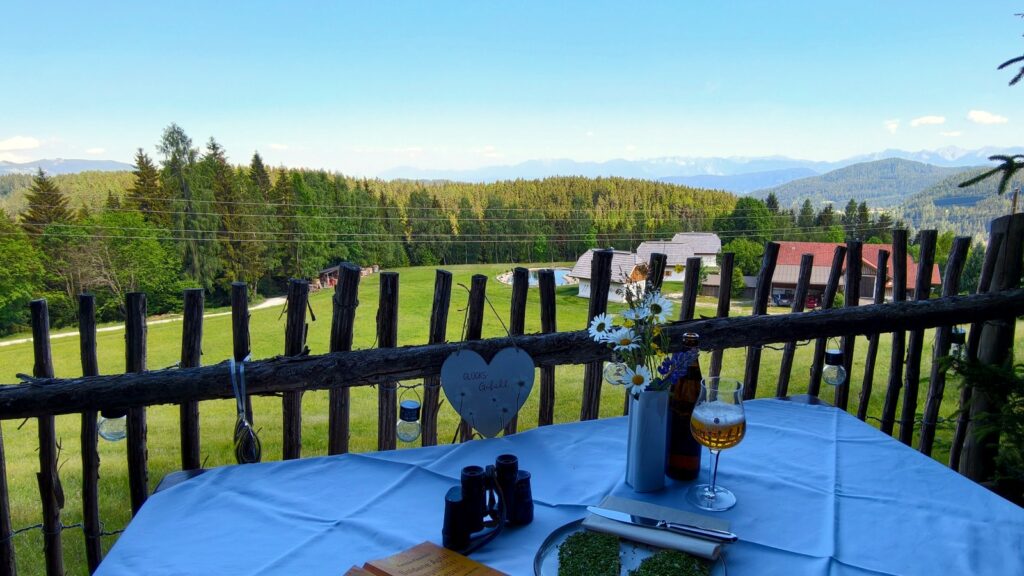
There are holiday destinations that look like retreats in photographs – but on arrival feel more like searching for parking, pool music and terrace conversations late into the evening. Those who wonder how to find quiet holiday spots are usually not just looking for a pretty landscape. They are seeking something rarer: a place where you slow down, sleep better, and aren't constantly overwhelmed by impressions.
This is precisely why it's not enough to just look for mountains, lakes, or a place in the countryside. Peace isn't a visual motif; it's a quality of the location, and it often only reveals itself in the details: in the positioning of a home, the number of accommodations, or in whether hosts combine proximity with sensitivity or if everything is geared towards a swift turnover.
How do I find quiet holiday destinations without disappointment?
The most honest answer is: by not looking for attractions first, but for what creates a sense of unease. Many travellers filter by wellness, lake views, or special design. This can be wonderful, but it doesn't automatically lead to relaxation. An architecturally beautiful house in a popular location remains a house in a popular location.
Those seeking true peace and quiet should first consider how a place operates. Is it on a main road or a high plateau? Are there many units in a small space, or only a few, deliberately placed retreats? Is the environment characterised by day visitors, excursion traffic and leisure activities – or by meadows, forests, small paths and a landscape that demands nothing of you?
Silence arises where nothing is constantly being offered. That sounds simple but is rarely consistently implemented in tourism. The more infrastructure is geared towards entertainment, availability and livening things up, the smaller the space for undisturbed relaxation becomes. A quiet holiday destination therefore doesn't have to be extremely remote. It simply has to be protected from what creates unrest.
The subtle clues that reveal good places
Anyone comparing accommodation will often recognise from the language used whether a place suits their needs. If the language is all about action, highlights, experience programmes or hotspots, it's about activation. If, on the other hand, materials, landscape, privacy, small rituals and personal recommendations are emphasised, this is usually a better sign of a slowing-down stay.
The size also reveals a lot. A house or a few houses spaced apart create a different atmosphere than an ensemble of many chalets, which, while appearing private, functions like a small holiday park. The same applies to restaurants, spa areas, and communal zones. What looks spacious at first glance often brings more encounters, more walking, and more noise.
A further pointer is the type of care provided. A personal hosting culture does not mean constant presence. At best, you sense that someone is there when you need them – and that otherwise, you are left in peace. This form of attention is often more valuable than a perfected service apparatus that treats every stay the same.
How do I find quiet holiday destinations in popular regions?
Just in Carinthia, In South Tyrol or in the Salzkammergut, an important difference becomes apparent: it's not the region alone that determines tranquillity, but rather the micro-location. A quiet spot can be just a few kilometres away from a well-known lake and still feel completely different. The crucial factor is whether you are situated on the flow of visitors or slightly off to the side.
Many beautiful areas are very busy in the summer and during long weekends. But that doesn't mean you have to avoid them. It just means looking more closely. Is the accommodation located above a place rather than right in the centre? Is there space around the house, or do terraces border directly on each other? Can you hear nature, wind, and perhaps a dog in the distance – or traffic noise, music, and the coming and going of other guests?
Those arriving by car often gain more flexibility here. This is because accommodation doesn't then have to be located right in the middle of the tourist bustle. This is often the better option, especially for couples and adults seeking peace and quiet: experience the region during the day, but return in the evening to a place that doesn't have to be shared with everyone.
Pictures show beauty – descriptions show how a place thinks
Many booking decisions fail because guests trust attractive pictures more than precise information. Photos show light, architecture, and views. They don't show how it feels at seven in the morning or ten at night. That's why it's worth reading the text carefully.
Does it mention anything about privacy, natural materials, few units, on-site retreats, or the tranquility of the house itself? Are the hosts spoken of as giving personalised recommendations rather than following a fixed itinerary? Is the surroundings described as a landscape – or as a collection of to-dos? Such phrasing is not a trivial matter. It reveals whether a place truly understands tranquility or merely uses it as a pretty word.
Sometimes, it also helps to look at what is not offered. No animation programme, No grand spa, no event-style setting, no standardised chalet business – this can be a strong quality feature for conscious travellers. Not everything that's missing is a loss. Sometimes, it's precisely what creates the space where relaxation becomes possible.
The most common mistakes when seeking peace
A common mistake is to confuse seclusion with loneliness. Many people don't want an isolated holiday, but a protected one. They want nature, good food, perhaps a lake or beautiful paths nearby – but without constant activity. A quiet holiday destination can therefore certainly be comfortable. What matters is not deprivation, but atmosphere.
The second mistake: expensive automatically means quiet. High-quality homes they can be wonderful, but if they are designed for maximum capacity, visibility and added extras, the peace remains superficial. Quality shows itself differently here: in materials, the feeling of space, distance, mindfulness, and the question of whether a place has character or merely features.
The third mistake concerns travel time. Off-season helps, but it doesn't solve everything. A lively place remains a lively place even in a quieter month, just a bit more subdued. Conversely, small, consciously managed guesthouses can seem remarkably quiet even during a popular time, if the location and concept are right.
Recognising genuine retreats
Genuine retreats don't aim to be everything to everyone. They cater to people seeking precisely what is often missing elsewhere: peace, privacy, natural beauty, and a form of hospitality that isn't intrusive. This is no accident, but a clear decision – and it can be felt.
Such places usually have a certain self-evidence about them. They don't need to assert their tranquility loudly. You can recognise them by their craftsmanship, by materials that radiate warmth, by little paths across meadows, by breakfast brought to your room, by a spot under trees that isn't staged but simply exists. When everything is designed to allow you to arrive rather than be kept busy, that's often the best sign.
Ebner 1822 in Carinthia embodies precisely this type of travel: a few carefully placed houses, personal hosts, Natural materials and a farm that understands retreat not as a marketing term, but as a lived reality. Those seeking this are not just looking for accommodation. They are looking for a place that does them good.
How do I find quiet holiday destinations that suit me?
Not every tranquil place is automatically the right one. Some guests want complete seclusion, others desire peace within the house but culinary quality in close proximity. Some travel with a dog and need nature right on their doorstep. Others value design, high-quality materials, and the feeling that beauty is not decorative, but real.
Which is why one last, often overlooked question is worth asking: what exactly should be quiet? The surroundings, the house, the daily routine, the encounters? Those who clarify this for themselves search more precisely and decide more confidently. Because tranquility is personal. For one person, it's a wooden house on the edge of a forest. For another, it's a place with a wide view, a Breakfast basket in the holiday home and an afternoon with no plans at all.
One rarely finds quiet holiday destinations where they are advertised the loudest. You find them where reduction is not a deficiency but a quality – and where you feel upon arrival that nothing more is expected of you. Perhaps that is precisely the rarest luxury today.
FAQ: Finding quiet holiday destinations
How do I really find quiet holiday destinations?
Don't just look at nice pictures, but above all consider the location, number of units, distance to other guests, and the type of care. Small houses, natural materials, plenty of space, and few predefined programmes are usually good indicators.
Is a remote holiday destination automatically quiet?
Not necessarily. Seclusion can help, but it doesn't guarantee recovery. The crucial factor is whether a place is protected from traffic, tourist activity, constant programmes and dense development.
Which regions are suitable for quiet holiday destinations?
Quiet holiday destinations are often found in regions with abundant nature, small trails and gentle landscapes. In Austria, places away from the main tourist flows are particularly suitable. In Carinthia, for example, the higher altitudes, the Gurk Valley, and the proximity to the Nockberge interesting for people seeking peace and quiet.
When looking for quiet accommodation, couples should consider the following: * **Location:** Opt for accommodation away from busy roads, train lines, airport flight paths, and town centres. Rural areas, villages, or properties on the outskirts of popular tourist destinations are often quieter. * **Room Type/Position:** Request a room that is not adjacent to noisy areas like reception, the main dining hall, lifts, or stairwells. Rooms on higher floors or those with fewer neighbouring rooms can also be more peaceful. * **Soundproofing:** Look for reviews that mention good soundproofing. This is particularly important in hotels where rooms are close together. * **Building Type:** Consider apartments, cottages, or holiday homes which may offer more privacy and less noise from neighbouring guests than a large hotel. Boutique hotels or guesthouses can sometimes be quieter than larger chain hotels. * **Amenities:** If the accommodation has facilities like a bar, nightclub, or swimming pool, check their location within the property to ensure your room isn't nearby. * **Reviews:** Pay close attention to guest reviews. Look for comments specifically mentioning noise levels, soundproofing, or the general atmosphere. Filter reviews by keywords like "quiet," "peaceful," "noisy," or "loud." * **Time of Year:** Visiting during the off-season or shoulder seasons can often mean fewer crowds and less noise. * **Host/Owner Communication:** If booking directly or through a smaller establishment, don't hesitate to contact the host or owner to explain your need for a quiet stay and ask about specific room options. * **Purpose of the Property:** A property marketed for families with children or for events might not be the best choice for a quiet retreat. Look for descriptions that emphasise relaxation or a peaceful atmosphere.
For couples, privacy, their own daily rhythm and an environment without constant stimuli are particularly important. A small holiday home or nature lodge is often more suitable than a large hotel with many communal areas.