When nature continues indoors
Some rooms feel right from the very first moment. Even before you can explain why. The light seems soft, sounds lose their harshness, wood and clay give warmth – and nothing seems to stand between a person and their surroundings.
Karl Steiner, the founder of Almdorf Seinerzeit, once spoke of the idea that natural materials follow the same original vibration as the human body. His thought was that when you enter a room made of wood, clay, stone, or wool, the body recognises something familiar. Artificial materials, lacquers, and chemical compounds can alter this natural interaction.
Whether one uses the word "vibration" for this or simply speaks of a good room atmosphere might not be crucial at all. Many people know the experience: some rooms make us relax immediately. Others remain cool and alien despite perfect furnishings.
At Ebner 1822, nature therefore continues inside the houses. Meadows and forests lie before the windows. Inside the house, wood, clay, and other natural surfaces remain visible and tangible. This creates a place where there is no sharp break between outside and inside.
Why natural spaces are good for us
Our daily lives are shaped by materials that we barely give a second thought to. Plastic, coatings, adhesives, and artificial surfaces are practical, easy to care for, and ubiquitous. They often attempt to imitate wood, stone, or other natural materials as perfectly as possible.
However, a wood-effect finish is not the same as wood. A printed pattern possesses neither its warmth nor its grain. It does not age in the same way and tells you nothing about the tree it came from.
Natural materials, on the other hand, remain alive. Wood reacts to heat and humidity. Clay can absorb and release moisture later. Wool warms without feeling artificial. Stone stores the temperature of its surroundings. These properties are not just perceived with the eyes. You can feel them when walking, touching, and breathing.
This doesn't mean that a room made of natural materials will automatically make all tension disappear. But it can create conditions under which arriving becomes easier: fewer artificial stimuli, pleasant surfaces and an atmosphere that feels familiar to the body.
Wood, clay and straw at Ebner 1822
The three nature holiday homes from Ebner 1822 were built from wood, straw and clay. The wood comes from their own forests. It supports the houses, forms floors and shapes many visible surfaces. Its grain was allowed to remain, as were small differences that make each plank unique.
The interior walls are plastered with clay. Its calm, matte surface changes with the daylight. In the morning it appears different than in the late afternoon when the sun falls deeper through the windows. At the same time, clay contributes to a balanced indoor climate because it can absorb moisture and release it back into the room air.
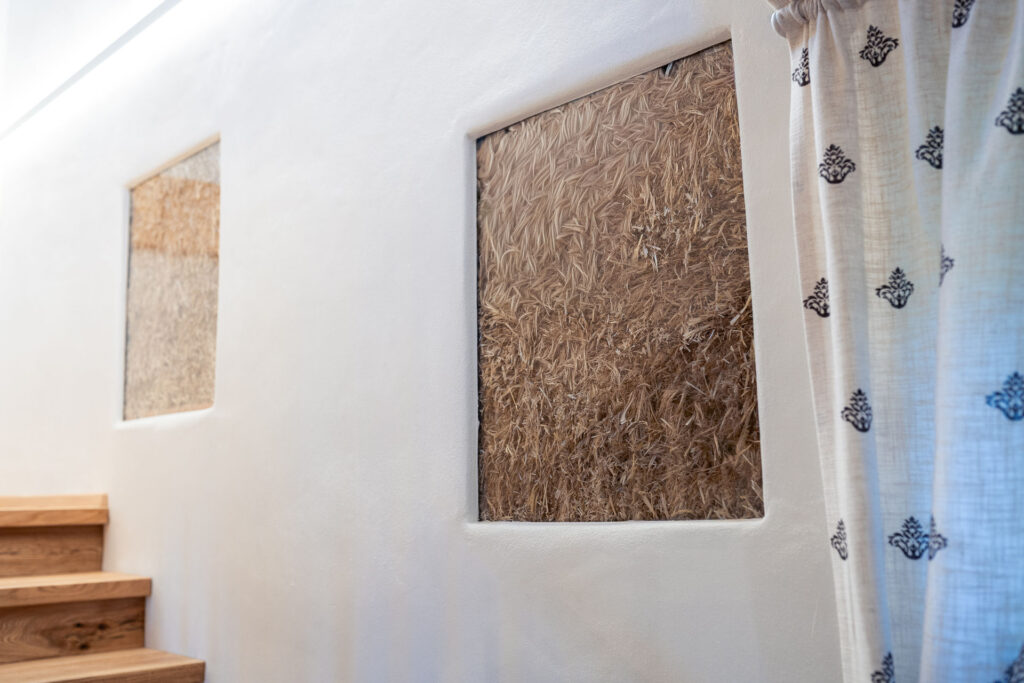
The straw remains invisible to guests. It's protected within the walls as insulation and keeps the house warm in winter. In summer, it helps prevent rooms from heating up too quickly. This means it works quietly and unobtrusively – without becoming part of a rustic display.
Oak floorboards, casement windows and larch shingles continue this material choice. They were not used to create a chalet-like backdrop. They belong to a construction method that considers the house as a whole.
Craftsmanship that can remain visible
Natural materials demand a different approach to building. They cannot be standardised in every detail nor reproduced at will. Wood has knots and variations in colour. Clay shows the handprint of the people who worked it. No two shingles are ever exactly alike.
That's precisely what makes it appealing.
At Ebner 1822, regional craftsmen were involved in the construction of the houses. They brought knowledge, experience, and a great deal of patience. Not every decision followed the quickest or easiest path. The key consideration was what would fit the location, the landscape, and the history of the farm in the long term.
The estate has been in family ownership since 1822. The new houses do not attempt to emulate this past. They continue it in a contemporary style: with clear architecture, generous rooms and the comfort that makes a stay pleasant.
Here, building in harmony with nature does not mean making sacrifices or embracing rustic simplicity. It means that a freestanding bathtub, a wood-burning stove, or a well-equipped kitchen can be part of a house that nevertheless remains characterised by honest materials.
Nature outside the windows and in the rooms
A Holiday with natural materials does not end at the front door. What surrounds the houses is also crucial.
Ebner 1822 is situated on a sunny high plateau at around 1,000 metres above sea level in the Carinthian Nock Mountains. Outside the windows, you'll see meadows, forests, and fruit trees. Depending on the season, you can hear birds, the buzzing of insects, rain on the larch shingles, or the crackling of the fire in the wood-burning stove.
The transition between indoors and outdoors remains fluid. From the warm wooden floor, the path leads onto your own terrace, from there continuing across the meadow or into the forest. Those lounging by the natural pond look back at houses that do not stand out like foreign objects in the landscape.
There is no artificially created opposition between the experience of nature outdoors and the feeling of living indoors. The landscape continues into the materials of the houses. The wood comes from the forest, the clay retains its earthy calm, and the straw is reminiscent of the fields, even when it is hidden within the walls.
Living at your own pace
The daily routine also follows this naturalness. In the morning, the breakfast basket is brought directly to the holiday home. Inside, you'll find fresh bread, carefully selected local products, and eggs from the four chickens Mathilde, Herta, Henriette, and Gertrude.
When the coffee is brewed and where breakfast is eaten is up to the guests. Perhaps at the table with a view of the meadows, perhaps on the terrace, or only after a first walk. The morning needs neither a dining room nor a set buffet time.
Barbara and Mario Sonnleitner are personally on site and are happy to give recommendations for walking paths, Excursions in the surrounding area or a special spot in the woods. At the same time, the privacy of your own home is maintained.
For those who don't want to cook in the evening, the village inn offers seasonal dishes made with regional and organic ingredients. Afterwards, the path leads back to your own house – to the wood under your feet, the light on the clay walls, and the landscape outside your windows.
No room needs to be perfect
Many modern interiors strive for flawlessness. Surfaces are meant to be smooth, colours perfectly uniform, and materials as easy to maintain as possible. However, rooms where everything appears faultless can also create a certain distance.
Natural materials are allowed to be different. A small branch in the wood, a fine unevenness in the clay or a spot that changes over the years does not detract from a room's quality. On the contrary: such traces make it visible that a house can be used and allowed to age with its inhabitants.
This suits a form of travel where not every moment needs to be staged. A day can remain quiet and unspectacular: a long breakfast, a walk through the forest, a swim in the natural pond, reading, or simply watching the weather over the meadows.
For Couples and guests seeking peace and quiet Perhaps relaxation lies in this. Not experiencing as much as possible, but perceiving more precisely what is already there.
Quality that doesn't need explaining
The award of Five flowers from a farm holiday confirms Ebner 1822's high quality standards. The company achieved 70 out of 70 points and was the first company in Austria to fulfil all requirements 100 percent.
But the special atmosphere of a house cannot be fully measured in points. It is evident in the warmth of a floor, in the quietness of a clay wall and in the scent of wood when the sun warms the room.
Perhaps it is indeed a shared vibration, as Karl Steiner described. Perhaps it is the interplay of light, air, material, and meticulous craftsmanship. In the end, personal perception is what truly matters: one enters a room and feels at ease.
At Ebner 1822, nature isn't confined to the doorstep. It accompanies guests throughout the entire house – quietly, naturally, and palpably.